When I Lived In Peru (Full performance)
Flash Gordon (Full Performance)
The above audio files are the complete and edited radio dramas we performed in
Flash Gordon Evaluation
When I Lived In Peru Evaluation
Compare and Contrast of Radio Plays
The above audio file is my comparison and contrast of the two radio plays I was apart of 'When I Lived In Peru' and 'Flash Gordon'
It looks at personal preparation as well as group preparation, looking at overall vocals and editing process as well as the use of sound-effects/music
Wednesday, 29 June 2016

Tuesday, 28 June 2016
Radio Play Classical Own Work
Flash Gordon
Preparation
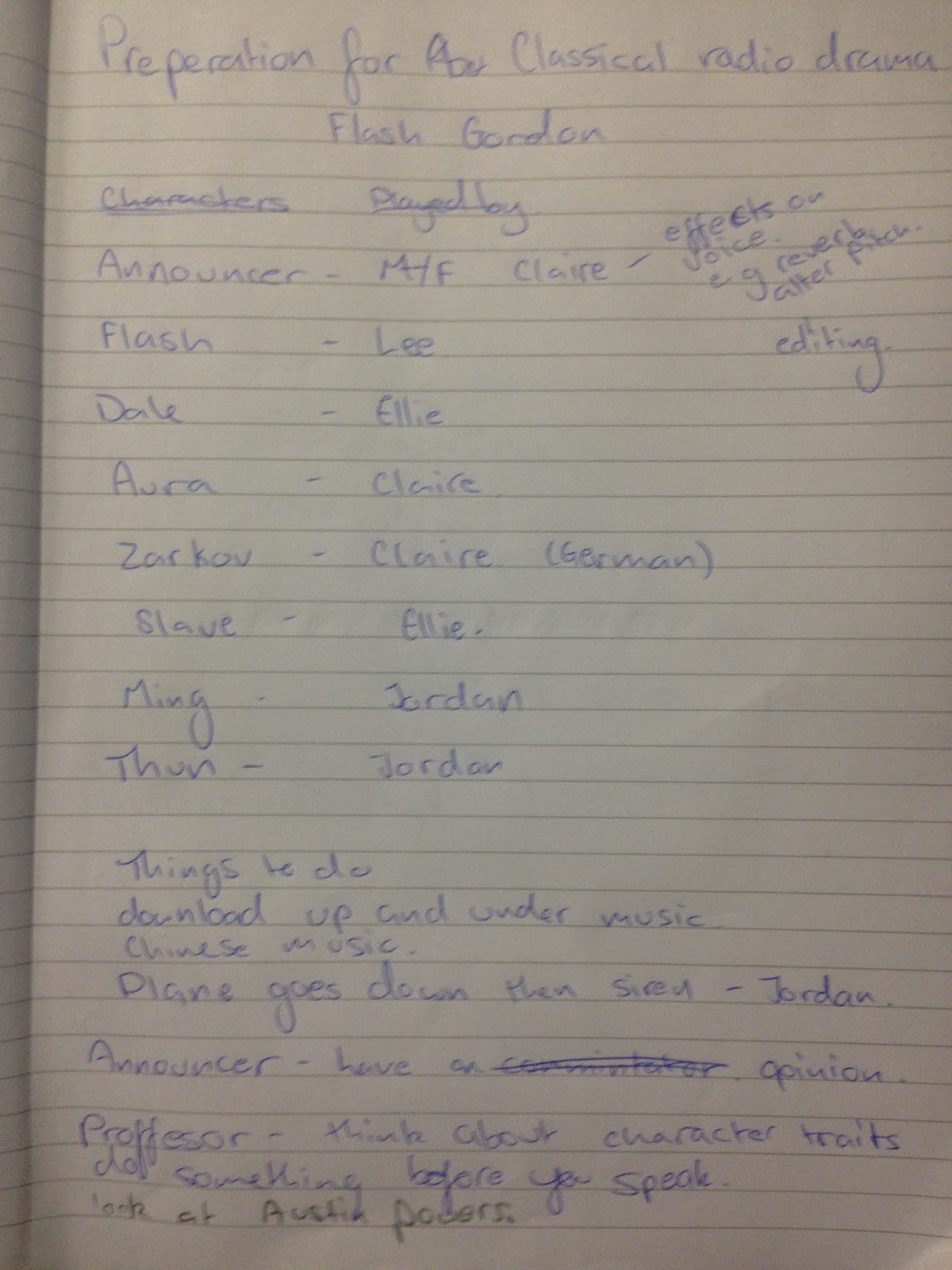
This picture is an image of the start of preparation made for Flash Gordon detailing who will play what part within the piece.


The images above are pictures of notes I made regarding my characters for Flash Gordon.
I watched the above video to get inspiration for my Announcer Voice. By listening to the various different radio personalities I made notes on specific ones who's way of talking would suit the Announcer voice in Flash Gordon
Zarkov
- Mad Scientist
- German
- Crazy, overly excited and hyper
I watched this video to help get an idea for the German accent as well as draw some of the mad scientist characteristics from the character. For Zarkov I will do a more hyper style to this, after having gone through the scene I feel this will suit him most.


The above two images are my marked script for Flash Gordon.
Vocals
This is an evaluation of my own vocals within the Flash Gordon Script
In this audio file I talk about my three characters, what I did well, what I could improve on and also peer feedback.
Radio Play's Contemporary, Own work
PREPERATION
 This is some character work I did before hand. I created a mini profile for my character detailing where she is from her age and her personality.
It is important to prepare like this before doing a radio drama as it will help you build a believable character that will come across believable Vocally.

This is a marked script of the scene my character is in. It is important to mark scripts and make notes on them, this helps with the development of the character and also allows you to try out new ideas when someone suggests them.
Notes on the script can refer to the emotional state of the character, a particular way to say something or accent to use/try.
In order to prepare for my character Natalia I also watched this video
I listened to the different styles of Spanish accent and when for Argentinian as I felt the energy of that accent suited Natalia.
This is one of the scenes from When I lived In Peru, I Play Natalia, one of Claire's friends who she met in Peru, I am married to Simon.
Accent: In the script it states that Natalia has an exotic accent and so I decided to go with a spanish dialect (Argentinian)
I held my accent strong throughout and didn't let it slip. this is essential when doing a character from a different place whether is be by county or country. if you slip up on accent then you will not put on a believable performance.
I use intonation throughout, altering my levels of pitch adding more character to her voice.
'Hello martin' - I started off with a higher pitch and go down to a slightly lower pitch near the end, the pitch at the beginning elevates my voice and makes it sound as though I want to be there.
'It felt so special and humble sitting amongst peasant folk simply taking their chickens to market' - Initially with this line i said it in a way that reflected an unintentional snobbish way, as if I was naive to the notion
However after rehearsing in the studio I got feedback, I was told to try it as though I was trying to overcompensate my wealth, and make myself seem richer than I was. the lines suggest this as an actually rich person is unlikely to refer to someone as peasants.
I felt my use of rhythm and intonation here worked well as the vocals sounded as though they slowed down slightly with more of an emphasis on some of the words, trying to show off and make sure Martin thinks I am wealthy.
Age: mid-30s
In the script it states that Natalia is in her mid-30's, I felt I was able to sound quite mature and was able to vocally portray the age well mostly
there were moments where when I was excited I could have added a bit more maturity into my vocals in order to sound slightly older.
In this scene I am a travel agent.
My character is bored, disinterested and fed up, not wanting to deal with customers for long.
Accent: Initially I tried my own accent for this, still in a fed up way. however I got feedback asking if I could try out this accent in stead a cockney like accent. At first I was stuck on how exactly to do the accent, however my fellow actor helped me by giving me an example and I was able to use that in order to re-create my character a bit.
I kept my accent strong throughout not breaking out of it, while still keeping the attitude my character has.
'So you'd liked to book a flight' the so at the beginning is slightly elongated, suggesting that she has been with Martin a long time already, the tone of her voice is slightly fed up as though she is going through the information again going slowly to piece together what Martin had asked her.
'Could you maybe pick a hemisphere' - the voice drops through the question and the use of levels I used a questioning and slightly pleading tone because I just want him to leave already and I seem to be getting no where.
'that's a mountain' - while going through things to do in Tanzania, this line is said with a tone of complete disinterest and boredom, showing how little my character cares at this point and that she doesn't want to be there.
Saturday, 11 June 2016
Radio Play (Classical) Professional work review

This is one of the Sherlock Holmes episodes. Watson wakes up and has to tend to a patient who's thumb had been cut off. When he treats the wound, the patient tells him what happened, mentioning a suspicious man visited his office called Colonel Lysander Stark, offering the engineer a lucrative pay for a job that seemed simple.
I will be looking at the vocal work for Dr Watson.
Character
Watson: Watson is the famous partner of Sherlock Holmes the British private detective. he is intelligent and inquisitive when it comes to usual cases, and will pass such cases onto his friend Holmes.
Age: based on the vocals in this drama I would say his age is Mid-Late 40s
Watson is both the narrator and a character within this story, he introduces the tale before we see it play out how it happened.
Vocals
Watson is addressing the listeners at the beggining he uses intonation, and makes changes in his tone, keeping the listener engaged in what he is saying as it adds more levels to his voice making him sound more interesting to the listeners.
'I will tell you about the case of the engineers thumb' - starting off on a lower tone, his tone rises on the will you and slowly again from 'about the case' his tone is composed and strong, he sounds as though he remembers the story personally, which suits as he has, the rise in pitch keeps readers interested as does the use of levels and intonations, which they use within it.
His voice sounds mature and there is no confusion in the difference in age between him and the patient he attends to at the beginning who's thumb was cut off.
When informed by the man for the first time that his thumb was cut off, you can hear the shock in his voice instantly, it's believable and doesn't sound forced, this is good as it means the listeners are more likely to believe in the characters.
'oh hold on a moment' - you can hear the clear, shock and slight uneasiness to his voice, it sound as though he is still trying to comprehend what happened and he needs to take moment to process what occurred.
'an attack' when the engineer mentioned it was an attack, there was element of curiosity and interest when he repeated the fact, this is shown as he goes on to say he will talk to his friend Sherlock Holmes.
Radio Plays (Contemporary) Professional Work review

Episode 1
By: Caroline and David Stafford
Directed by: Marc Beeby
Summary: After an accident lands her in hospital, Mother and Grandmother Christine, who until this point has hidden her past, now must reveal her history of her past relationships with unsuitable men and the adventures they went on.
I am looking at episode 1 where she tells the first story about the queens coronation and her role in kidnapping an important horse
I will be looking at the Vocal work of the vocal actress playing the daughter of Christine the woman in Hospital, Sally.
Character
Sally: It is established early on in the episode that Sally is the daughter of Christine. She is a mother herself of an 18 year old daughter. She seems to worry a lot due to the fact that her mother had an accident and her daughter had not contacted her in a few days. A caring mother and daughter she only wants whats best for her mother, worried over her current health.
Age: I feel Sally is in her early 40s this is because she does have a daughter of 18 years. She also has a mature voice (although more youthful than Christine's).
Vocals
Conversation Between her Mother about the accident and what to do (first 3 minuets)
At the beginning Sally is discussing with her mother the doctors advice as well as the accident.
'They don't want to discharge you' - the they is emphasised in this sentence in order for her to make sure her mother listens as she continues talking regarding what the doctors have said, trying to make her mother understand she needs to be taken care of.
'You had a very nasty fall' - there is a rise in pitch during this statement and an emphasis on fall, she is trying to emphasise this to her mother so she'll understand what happened to her mother.
During this conversation with her mother, there is a worried tone to her voice at times as well as a calm strong slightly argumentative tone when confronting her mother about the situation. the use of intonation and confrontation shows her concern for her mother after the incident and her worry over future consequences such as memory loss as a result of the hit to the head.
her calmness comes from dealing with her headstrong stubborn mother.
'I thought, you should come and stay with us' - her pitch lowers slightly on thought, showing a sense of apprehension with what she is about to say next, unsure of how her mother may react to her idea.
'we could go to the beach, you like the sea' - at this part she uses intonation to emphasise the point, her tone is hopeful, as she knows this is something her mother enjoys and so she emphasises it more as she feels this is a selling point to the idea.
'everybody's trying their best to help mum' - her voice is slightly strained on everybody's as well as an underlying exasperated tone the tense voice appearing to show she is trying to remain calm and keep her emotions in check.
Conversation leading into Christine's story
She is happier in this section, as she goes through some of her mothers photos with her and asks her questions, she is intrigued and wants to know the story behind it.
She uses a lighter tone that shows her interest in the pictures and a curiosity to know more about them.
'You never told me you had a pony' - the use of intonation adds levels to her voice and shows that the fact interests her, there is a rise of pitch at the end of Pony, adding a lighthearted touch to the statement. the statement starts of lower and rises, with elements of intonation throughout and shows an underlying sense of curiosity.
'It's you' a rise in pitch here, her tone is confident, she's sure it's her mum, but there is also this sense of she knows it's her mum but is it defiantly her mum.
'Who took the photograph then, was it your dad, was it grandad' - there is a use of inflection on dad and grandad, adding an emphasis on the two, as she tries to find out who took the photo of her mother.
Friday, 10 June 2016
Radio Drama (Intro)

Radio Drama
Radio dramas are plays that rely solely on the vocals of the actors as well as sound-effects and music. Often played on the radio, these dramas have a range of genres just like T.V. such as crime shows, thrillers, comedy, soaps. They rely completely on sound in order to hook the listener in to keep listening.
Format + Script (breaking down, analysis)


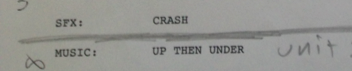


Format + Script (breaking down, analysis)

The picture above is of the first page of Flash Gordon episode 1 (radio drama), a science fiction drama that ran in the 1930's.
Names
The names are in all capital letters followed by a colon, which is then followed by their speech/action. In this script the Announcer was shortened to ANNCR. In this Script they use the first names of the characters for Flash and Dale. The dialogue remains in the normal upper and lowercase format.
Sound Effects/music/other sound direction


on scripts sound effects have SFX beside them, much like the name, with a description beside them. unlike dialogue the description on the sound is also in capital letters.
The reason sound effects are written in is to inform the directors/editors and production team, the kind of sound effect to be added to the final edited piece, it's written in within the script as a separate line to give the editor who edits the piece at the end and adds the sound-effects the knowledge of where the sun-effect is meant to be placed.

It is important to note in scripts that although the SFX will be written on a separate line the script, the sound effect can happen during dialogue, it will be edited in during post-production. The sound-effect above 'TURNS WHEEL ON DOOR TO CRANK IT SHUT" in our version of the radio drama we had the sound effect play during Dale's dialogue after.
As the editor I chose to do this because I felt it worked with the flow of the piece more. I Imagine Zarkov would be the one to close the door while Dale and Flash enter the ship.

This crash sound effect happened in-between the pieces of dialogue and acts like a change between areas. From being on the ship to arriving on the 'planet'.
Music: sometimes scripts will have music cues in them in the case of this scrip MUSIC: UP AND UNDER that is the music listed for most of the script suggesting it is the plays main theme, that often happens at intersections within the script singling the swap from one area to another.
Target Audience
Flash Gordon is a Science-fiction radio drama that follows the adventures of Flash Gordon.
The Flash Gordon radio drama followed the story of the Sunday comic strip of the same name. Flash Gordon is, like a comic book hero.
I feel the target audience is for 13-17 year olds mainly, although at the time of original release could also appeal to young adults.
Preparation
In the modern world of radio drama, when cast as a part I was surprised to find out from Industry professional Peter Greenall who had recently acted in the BBC drama 'Hood' that you will often get the full script a couple of weeks in advance, if you're lucky and normally it will only be a few days before recording begins.
This means it is vital to start looking at a script as soon as possible, breaking down the scenes and getting a clear understanding of what is happening.
Peter recommended making sure you have a clear understanding of what is happening in each scene, and developing ideas for your character.
If you have a bigger role he recommends emailing the director with your thoughts on what's happening in the scene and about your character for them to see and comment on, telling you your spot on or no and informing you of how they want it.
Another important thing to note is that you will not necessarily be working or recording with any of the other actors during the recording process.
Thursday, 9 June 2016
Equipment and Software (At home Recordings)

Equipment And Software
In this part I'll be showing you the equipment and software I use at home and in college to record and edit my audio files.
Software - GarageBand

If you want to add sound effects or music to the track it's fairly straight forward, if you have a sound file of the sound effect you will be able to drag the track onto garageband and it will be copied onto there, free for you to edit in the way you want it.
Equipment

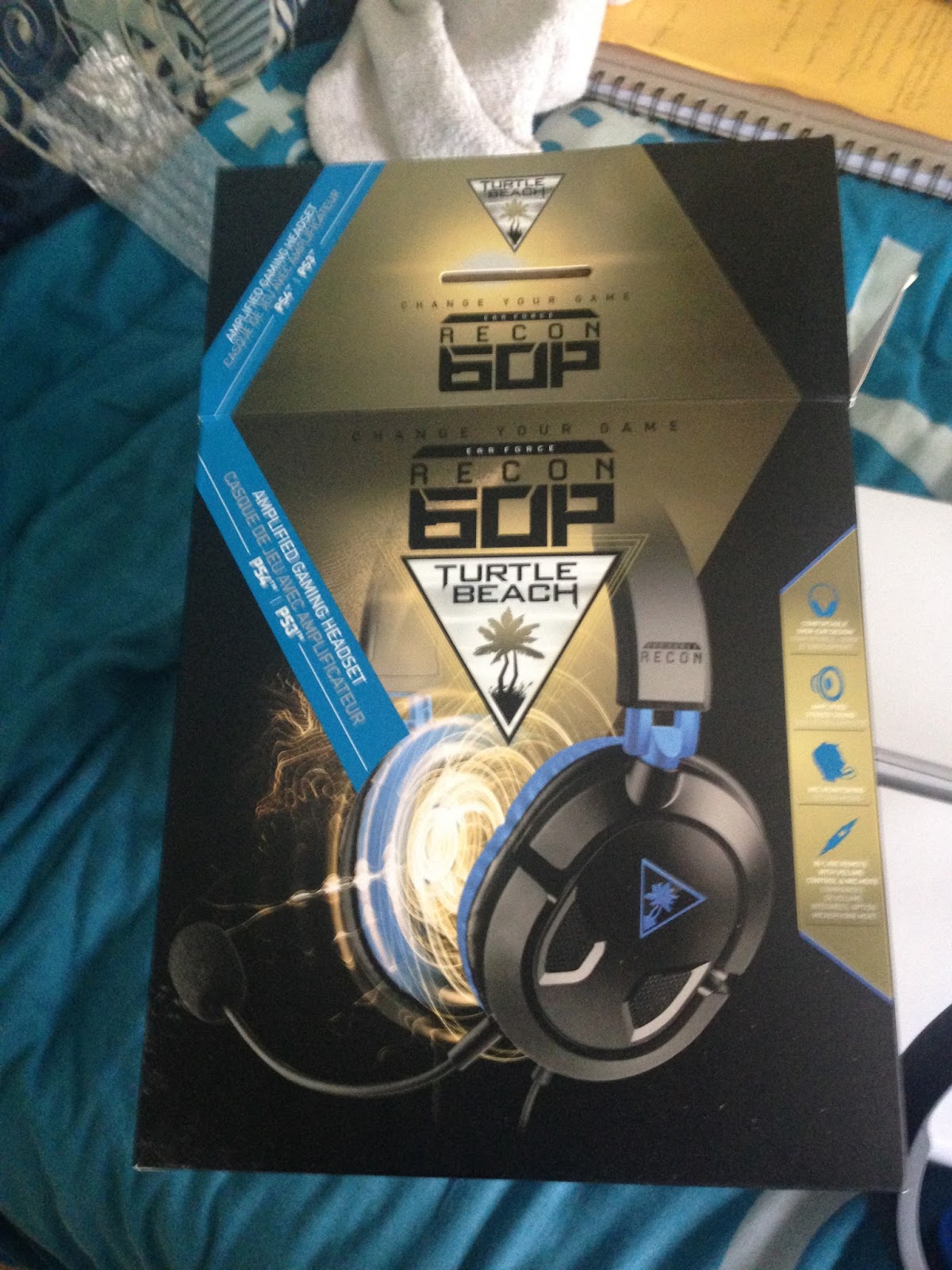
The main equipment I use at home is my MacBook Air and the Turtle Beach Reacon Headphones. Although they are designed as a 'Gamer' headset, they are very good for solo recordings. when you plug them in with garageband up and option will appear with how you want to record. Make sure the Microphone is switched on and that the Input device is selected as the headphones/microphones or if you are using a different mic then as that microphone.
These Headphones are good for solo work and experimentation. If you're a beginner just starting out and you don't have a lot of money to spend on equipment these headphones only cost around 30-40 pounds and can get you started.

Snowball Mic
The Snowball Mic is another microphone I have used in recording. If you want to try out recording with your friends this is a good option, it's open and therefor you are not restricted to one person speaking into the microphone.
You want to make sure that the room you are recording in is completely silent however as this mic is able to pick up sounds from a fair distance. You could also get some Acoustic foam boards to help insulate the sound in the room

Another suggestion made for insulating sound was made by Peter Greenall, the professional who came to see us, who when I was discussing where I had recorded my Charlie and Lola piece mentioned the idea of getting bed sheets and hanging it across the walls to work as make-shift insulators. This can help with money costs as you would not have to buy acoustic tiles and is also useful if you need to record something at home.
Subscribe to:
Posts (Atom)